Source Physical Oil Refinery for Edible Oil, Grease, and Petrochemical Uses
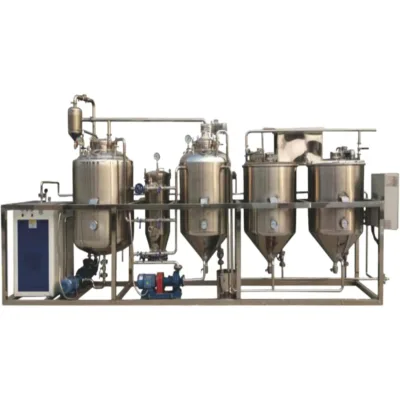
Find and compare 30 Physical Oil Refinery units from Henan, China, featuring horizontal and vertical designs with 380V voltage. These machines support capacities from 1-500t/D for edible oil production lines, grease processing, and petrochemical applications, with customization available.
Key considerations
Products List


$49500.00 - $50000.00
MOQ: 1 Pieces


Sunflower Oil Refinery Machineoil Refinery Machinery Equipmentsmall Oil Refinery Machine
$2100.00 - $2200.00
MOQ: 1 Pieces


Oil Refinery Machinery Equipment Oil Refinery Equipment Cooking Oil Refining
$7800.00 - $7853.00
MOQ: 1 set


Small Scale Oil Refinery Oil Refinery for Sale Mini Crude Oil Refinery at Factory Price
$3599.00 - $4599.00
MOQ: 1 Pieces

$50000.00 - $100000.00
MOQ: 1 Sets
SHANGQIU ZHONGQING ENVIRONMENTAL PROTECTION SCIENCE AND TECHNOLOGY CO., LTD.

$50000.00 - $300000.00
MOQ: 1 Sets
SHANGQIU ZHONGQING ENVIRONMENTAL PROTECTION SCIENCE AND TECHNOLOGY CO., LTD.


Comprehensive Sourcing Guide
Physical Oil Refinery Sourcing Guide
Sourcing a Physical Oil Refinery requires a disciplined approach to distinguishing between crude oil processing units and edible oil extraction machinery, as the terminology often overlaps in global trade directories. Buyers must first clarify whether the procurement goal involves refining crude petroleum into fuels and lubricants or processing vegetable oils such as soybean, corn, or sunflower seed into edible products. The supplied market data indicates a significant presence of equipment labeled as "refinery machines" that are actually designed for the physical pressing and extraction of vegetable oils, characterized by horizontal or vertical press structures and capacities ranging from 1 to 500 tons per day. This distinction is critical because the technical specifications, safety requirements, and downstream applications for these two categories are fundamentally different.
The procurement landscape for these machines is dominated by suppliers originating from Henan Province, China, which is a recognized industrial hub for oil press equipment. Listings frequently highlight models such as HTJL-11, HL, CC, and HLO, suggesting a modular or series-based product line rather than a single monolithic unit. Buyers should observe that while some listings refer to "crude oil refinery," the accompanying attributes like "Press Materials: Soybean" and "Function: Refining Vegetable Oil" confirm that the actual hardware is intended for edible oil production lines. Understanding this semantic nuance prevents costly misalignment between the buyer’s raw material feedstock and the supplier’s equipment capabilities.
Product Scope and Observed Listing Signals
The observed product scope encompasses a wide variety of configurations, including complete sets of grease equipment, single press units, and full edible oil production lines. Listings indicate that these machines are available in both horizontal and vertical structures, allowing buyers to select based on their factory layout and automation preferences. The voltage specification is consistently noted as 380V, which is standard for industrial three-phase power in many regions, but buyers must verify local grid compatibility before finalizing orders. The condition of the equipment is uniformly listed as "New," implying that the market is primarily driven by fresh manufacturing rather than refurbished second-hand machinery, which simplifies the initial quality assessment for new plant installations.
Capacity and throughput are significant variables in the current market, with standard models offering capacities such as 10 TPD (tons per day) and 20 TPD, while broader ranges extend up to 500 tons per day. This scalability allows small-scale processors to start with compact units and expand to large-scale extraction plants without changing suppliers. The raw materials supported include soybean, corn, cottonseed, peanut, and sunflower seed, indicating that the Physical Oil Refinery equipment is versatile enough to handle a diverse range of agricultural feedstocks. Buyers should note that the "Advantage" listed as "High Oil Press Yield Rate" is a common marketing claim, and verification of actual yield performance against specific raw material batches is essential before committing to a purchase.
Technical Specifications to Verify
When evaluating the technical specifications of a Physical Oil Refinery, the first priority is confirming the press structure and orientation. The market data shows a mix of horizontal and vertical designs, each with distinct maintenance and operational implications. Horizontal presses often facilitate easier cleaning and continuous operation, while vertical presses may offer a smaller footprint. Buyers must verify the motor power, screw diameter, and barrel material composition, as these factors directly influence the mechanical pressure applied to the seeds and the resulting oil extraction efficiency. The "Press Series" attribute listed as "Second" in some contexts may refer to a secondary pressing stage or a specific model series, requiring clarification from the supplier to ensure it aligns with the desired extraction process.
Packing and shipping logistics are also critical technical considerations, as these machines are typically large and heavy. The observed packing methods include standard export packing, wooden boxes, and containerized shipping, which affects the cost and safety of transit. Buyers should verify whether the equipment is disassembled for container loading or shipped as a complete unit, as this impacts the on-site assembly requirements. The "prod_standard" varies depending on capacity and model, meaning that a 10 TPD unit will have different dimensional and weight specifications compared to a 500 TPD line. It is imperative to request detailed engineering drawings and weight distribution charts to ensure that the factory floor can support the equipment and that the shipping containers can accommodate the dimensions without excessive oversize fees.
Compliance and Safety Documentation
Compliance with international safety standards is non-negotiable for any Physical Oil Refinery, particularly those operating at high pressures and temperatures. Buyers must request certificates of conformity for electrical components, ensuring that the 380V motors and control panels meet local electrical codes and international standards such as IEC or CE. The "Standard Export Packing" mentioned in listings often implies adherence to basic international shipping norms, but this does not equate to operational safety certification. Buyers should insist on detailed safety manuals that cover emergency stop procedures, pressure relief valve settings, and lockout/tagout protocols for maintenance personnel.
In the context of edible oil production, food safety compliance is equally important. The equipment must be constructed from materials that are safe for food contact, typically stainless steel grades that resist corrosion and do not leach harmful substances into the oil. Buyers should verify the material specifications for all parts that come into direct contact with the raw seeds or the extracted oil. Additionally, if the refinery is intended for large-scale industrial use, environmental compliance documentation regarding noise levels and waste oil management should be reviewed. The "Application Area" listed as including the Food Industry underscores the need for hygiene-focused design features, such as smooth surfaces that are easy to clean and sanitize between production batches.
Cost Drivers and Commercial Terms
The cost of a Physical Oil Refinery is driven by several key factors, including capacity, automation level, and material quality. Listings show a wide price range, from $0.5 to $3,000,000, reflecting the disparity between small-scale benchtop presses and fully automated large-scale production lines. Buyers should understand that the "MOQ" (Minimum Order Quantity) is often listed as 1, indicating that suppliers are flexible with order sizes, but this may come with higher per-unit costs for smaller orders. The "Customization" attribute being available suggests that buyers can tailor the machine to specific raw materials or capacities, but customization typically incurs additional engineering and manufacturing fees.
Commercial terms such as payment methods, warranty, and after-sales support are critical components of the procurement agreement. Buyers should negotiate clear terms for spare parts availability, as wear components like screws and barrels will require periodic replacement. The "prod_packing" method can also impact the total landed cost, as wooden crate packing may be more expensive than standard export packaging but offers better protection for delicate components. It is advisable to clarify whether the quoted price includes installation guidance, operator training, and commissioning services, as these services can significantly reduce downtime and ensure optimal performance during the initial production phase.
Supplier Qualification and Quality Control
Qualifying a supplier for Physical Oil Refinery equipment requires a thorough review of their manufacturing capabilities and quality control processes. Buyers should verify the supplier’s production history, specifically their experience in manufacturing equipment for the specific type of oil they intend to process. The concentration of suppliers in Henan Province, China, offers a competitive market, but it also necessitates rigorous due diligence to distinguish between reputable manufacturers and trading companies. Requesting video tours of the production facility and recent client references can provide valuable insights into the supplier’s operational reliability and product consistency.
Quality control measures should include factory acceptance tests (FAT) where the machine is run with actual raw materials to verify oil yield and purity. Buyers should insist on a detailed inspection report that covers dimensional accuracy, electrical safety tests, and pressure integrity checks. The "Condition: New" attribute should be backed by a certificate of origin and a bill of materials that lists all major components and their manufacturers. Establishing a clear quality assurance protocol before shipment helps mitigate the risk of receiving equipment that does not meet the specified performance standards, ensuring that the investment yields the expected return on investment.
Long-Term Procurement Checks
Long-term procurement success depends on the supplier’s ability to provide consistent support and spare parts availability over the lifespan of the equipment. Buyers should establish a formal relationship with the supplier that includes a commitment to supply wear parts for at least five to ten years, as these components are subject to regular replacement. The "Customized" nature of many orders means that standard spare parts may not be interchangeable, so maintaining a direct line of communication with the original manufacturer is essential for troubleshooting and maintenance. Regular performance audits of the installed equipment can help identify deviations in oil yield or efficiency, allowing for timely adjustments or part replacements.
Furthermore, buyers should stay informed about technological advancements in oil pressing and refining, as newer models may offer improved energy efficiency or higher extraction rates. Periodic reviews of the supplier’s product catalog can reveal opportunities for upgrading existing lines or expanding capacity with compatible equipment. Building a long-term partnership with a reliable supplier can also facilitate better pricing on future orders and priority support during critical production periods. By focusing on these long-term checks, buyers can ensure that their Physical Oil Refinery remains a productive and profitable asset for years to come.
FAQs
What is the standard voltage for these refinery machines?
The standard voltage for these machines is 380V. This specification applies to the new condition units available from Henan Province, China, ensuring compatibility with industrial power grids for efficient operation.
Can I request custom packaging for the equipment?
Yes, customization is available for packaging requirements. Options include standard export packing, wooden boxes, or container shipping, depending on the specific model and capacity needs of your large-scale oil extraction plant.
Which raw materials can be processed by this equipment?
The equipment handles various raw materials including soybean, corn, cottonseed, peanut, and sunflower seeds. It is designed for edible oil production lines with high oil yield rates suitable for diverse agricultural inputs.
What is the minimum order quantity for these machines?
The minimum order quantity is one unit. This low MOQ allows buyers to start with a single machine, such as the HTJL-11 or HL models, without needing to commit to large bulk orders immediately.
How is the equipment shipped from the factory?
The equipment is shipped via container or packed in wooden cases. Shipping methods depend on the model and capacity, ensuring safe transport from Henan, China, to international destinations for various industrial applications.
What capacity ranges are available for these refinery units?
Available capacities range from 1 to 500 tons per day. Specific models like the 20TPD unit offer standardized sizes, while others vary based on the required production scale for the petrochemical or food industry.